

For families in our service areas
For families in our service areas, this guide explains caregiver support and how non-medical in-home caregiving can support care planning in East Idaho, Treasure Valley & Magic Valley, Northern Wasatch, North Central West Virginia, and Northeast Ohio.
Understanding Choosing the Best Mobility Aids
Navigating mobility aids for seniors presents a significant challenge for caregivers. With numerous options available - from canes to electric scooters - understanding the unique benefits and limitations of each device is essential. This complexity can leave caregivers feeling overwhelmed, as they strive to enhance their loved ones' independence and quality of life.
To effectively assess the specific needs of seniors, caregivers must consider several factors:
- What are the mobility challenges faced by the individual?
- How do these challenges impact their daily activities?
By addressing these questions, caregivers can make informed decisions about the most suitable mobility aid.
This article explores the essential factors to consider when selecting mobility aids, providing valuable insights and practical solutions. With the right information, caregivers can confidently choose the best options to empower their loved ones.
Understanding Mobility Aids for Seniors
Mobility aids for seniors play a vital role in assisting them with movement difficulties, a challenge that can significantly impact their autonomy and quality of life. Without the right support, seniors may struggle with daily activities, leading to decreased independence and increased reliance on caregivers.
These devices range from basic tools like canes and mobility aids to more advanced options such as wheelchairs and electric vehicles. Each type serves a unique purpose, addressing various levels of movement impairment. For example, canes offer minimal support for those with slight balance issues, while wheelchairs provide full-body support for individuals who cannot walk.
Understanding these distinctions is essential for caregivers. By selecting the most appropriate mobility aids for seniors, they can ensure safety and comfort in their daily activities. Here are some actionable tips for caregivers:
- Assess the level of mobility impairment to choose the right device.
- Consider the senior's lifestyle and preferences when selecting a supportive device.
- Consult with healthcare professionals for personalized recommendations.
By being informed and proactive, caregivers can significantly enhance the quality of life for their loved ones.

Comparing Walkers, Wheelchairs, and Scooters
Seniors often face significant challenges in maintaining their independence and mobility when it comes to using mobility aids for seniors like walkers, wheelchairs, and scooters. These challenges can lead to decreased confidence and increased risk of falls, making it essential for caregivers to understand the options available.
Walkers provide excellent stability and support for seniors who can bear weight but need help with balance. They are lightweight and portable, making them particularly effective for indoor use. However, users must be able to lift and advance the device, which can be a limitation. Studies indicate that walkers can greatly enhance movement for seniors, with many users reporting increased confidence and a reduced chance of falls.
Wheelchairs, available in manual and powered versions, cater to individuals with significant movement restrictions who cannot walk. They offer comprehensive body support and can be used in various settings, both indoors and outdoors. However, maneuvering wheelchairs in tight spaces may require assistance, which can be a challenge for caregivers.
Personal Transporters, designed for longer distances and outdoor activities, are battery-operated and feature comfortable seating. They are ideal for seniors who wish to maintain their independence but struggle with walking long distances. However, two-wheeled vehicles can be bulkier and less maneuverable in tight areas compared to walkers. Notably, around 70% of users find it easier to meet people and engage in community activities after acquiring a scooter.
Each of the mobility aids for seniors presents unique benefits and drawbacks, making the choice dependent on the elder's movement capability, lifestyle, and specific needs. Occupational therapists emphasize the importance of evaluating personal requirements to select the most suitable assistance device. Real-life examples show elderly individuals effectively using wheelchairs and mobility devices to participate in community activities, highlighting the significance of these aids in fostering independence and social interaction.

Selecting the Right Mobility Aid: Key Considerations
Selecting the right mobility aids for seniors can be a challenging task. Caregivers often face the problem of ensuring that the chosen device meets the specific needs of the individual, which is crucial for maintaining their independence and safety.
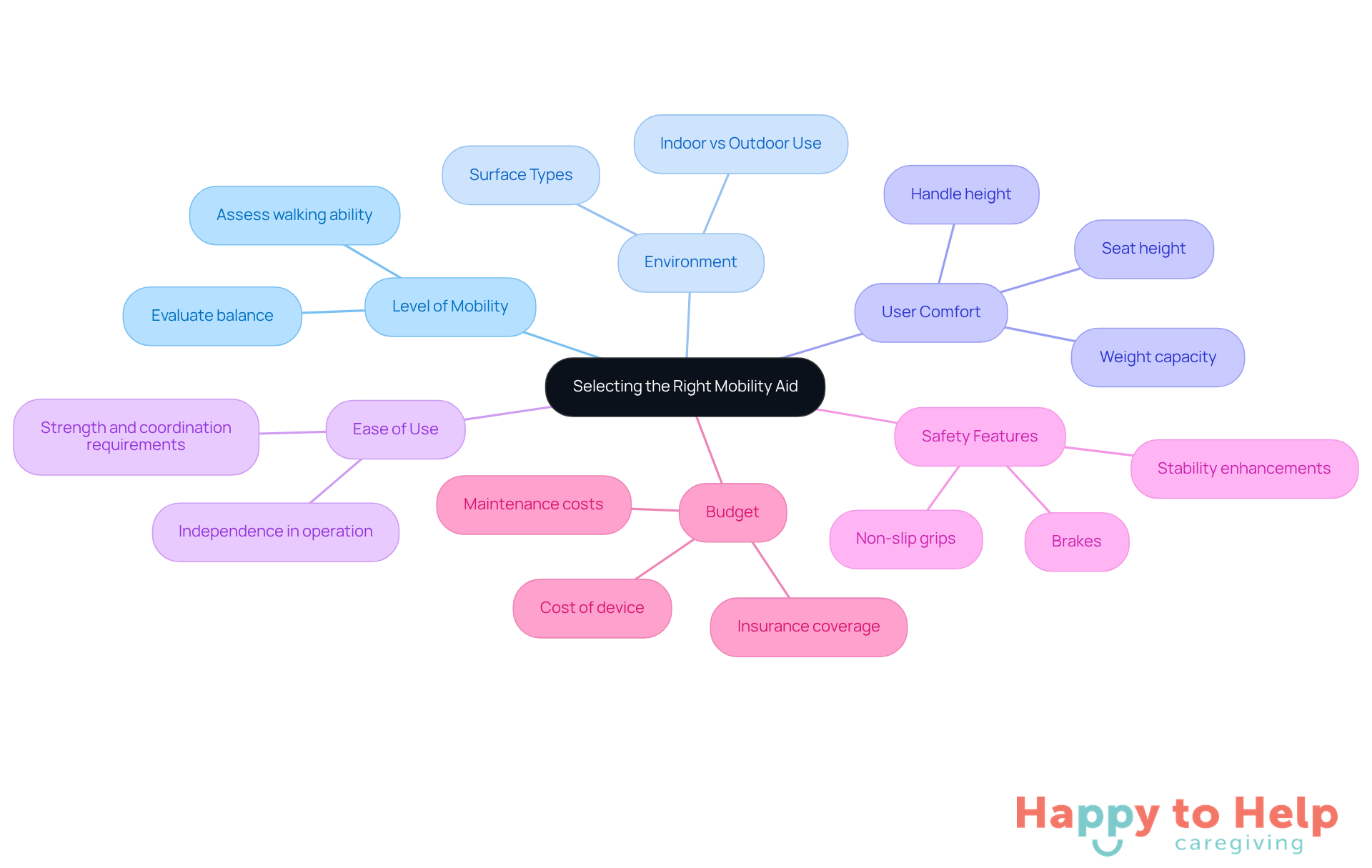
To address this issue, consider the following key factors:
-
Level of Mobility: Assess the senior's ability to walk and their balance. This will help determine whether a cane, wheelchair, or other mobility aid is most suitable.
-
Environment: Think about where the assistive device will be used. For example, walkers are ideal for indoor settings, while scooters are better for outdoor use.
-
User Comfort: Ensure that the device is comfortable for the user. Check aspects like seat height, handle height, and overall weight capacity.
-
Ease of Use: Evaluate how simple it is for the senior to operate the device independently. Some aids may require more strength or coordination than others.
-
Safety Features: Look for essential features such as non-slip grips, brakes, and stability enhancements to minimize the risk of falls.
-
Budget: Consider the cost of the assistive device, including potential maintenance or accessory expenses. Some aids may be covered by insurance, while others might require out-of-pocket payments.
By carefully considering these factors, caregivers can select the most suitable mobility aids for seniors that enhance the senior's independence while ensuring their safety.
Moving Forward with Choosing the Best Mobility Aids
Selecting the right mobility aids for seniors presents a significant challenge for caregivers. Many seniors struggle with mobility issues, which can severely impact their independence and quality of life. Without the right support, they may feel isolated and unable to participate fully in their communities.
To address this problem, caregivers must understand the various mobility aids available, such as walkers, wheelchairs, and scooters. Each of these aids serves different needs based on individual mobility levels. For instance, walkers provide stability for those with some mobility, while wheelchairs and scooters cater to more significant mobility challenges. Evaluating a senior's mobility capabilities, lifestyle preferences, and the environments in which the aids will be used is essential.
Caregivers should take a proactive approach in assessing these needs. Consider factors like user comfort, ease of use, safety features, and budget when making decisions. By doing so, caregivers can ensure that the chosen mobility aid enhances safety and comfort, ultimately empowering seniors to engage more fully in their communities.
In conclusion, the right mobility aid can significantly improve a senior's independence and overall well-being. Caregivers are encouraged to utilize the insights provided to make informed choices for their loved ones. This not only enhances the daily lives of seniors but also contributes to their happiness and quality of life.
https://iframe.tely.ai/cta/eyJhcnRpY2xlX2lkIjogIjY5MjI0ZjU4NGZjYWRhOTUwOGRlNDNiZCIsICJjb21wYW55X2lkIjogIjY4ZWU1ZGNhNzMxNzYyNTU3ZjNjOTVjMSIsICJpbmRleCI6IG51bGwsICJ0eXBlIjogImFydGljbGUifQ==Frequently Asked Questions
What are mobility aids for seniors?
Mobility aids for seniors are devices designed to assist individuals with movement difficulties, helping to improve their autonomy and quality of life.
Why are mobility aids important for seniors?
They help seniors manage daily activities, reduce reliance on caregivers, and maintain independence despite movement challenges.
What types of mobility aids are available for seniors?
Mobility aids range from basic tools like canes to more advanced options such as wheelchairs and electric vehicles, each serving different purposes based on the level of movement impairment.
How do canes and wheelchairs differ in their support?
Canes provide minimal support for individuals with slight balance issues, while wheelchairs offer full-body support for those who cannot walk.
What should caregivers consider when selecting mobility aids for seniors?
Caregivers should assess the level of mobility impairment, consider the senior's lifestyle and preferences, and consult healthcare professionals for personalized recommendations.
How can caregivers enhance the quality of life for seniors using mobility aids?
By being informed about mobility aids and proactively selecting the appropriate devices, caregivers can significantly improve safety and comfort in seniors' daily activities.
List of Sources
- Understanding Mobility Aids for Seniors
- See Why Seniors Deserve the Best Mobility Aids for Unbeatable Comfort and Freedom - Wheelchair & Mobility Scooters Guide (https://1800wheelchair.com/news/see-why-seniors-deserve-the-best-mobility-aids-for-unbeatable-comfort-and-freedom?srsltid=AfmBOoquxjHr2fM\_7Kq2FAHOykwdolQL1v4Ye-Du9qOmJOrYQqZ\_ZUUG)
- The Importance of Mobility Aids for Seniors - Bethesda Health Group (https://bethesdahealth.org/blog/the-importance-of-mobility-aids-for-seniors)
- Comfort Keepers of Pitman, NJ Shares the Benefits of Mobility Aids for Seniors (https://kron4.com/business/press-releases/ein-presswire/866931728/comfort-keepers-of-pitman-nj-shares-the-benefits-of-mobility-aids-for-seniors)
- New Lightweight Mobility Devices Cater to Active Elderly - INTCO Medical (https://intcowheelchair.com/news/new-lightweight-mobility-devices-cater-to-active-elderly)
- Breaking News: Fall 2025 Brings a New Era of Lightweight Walkers and Rollators for Seniors (https://cbs42.com/business/press-releases/ein-presswire/850373373/breaking-news-fall-2025-brings-a-new-era-of-lightweight-walkers-and-rollators-for-seniors)
- Comparing Walkers, Wheelchairs, and Scooters
- Are Mobility Scooters for Disabled a Smart Investment for Better Mobility? - Wheelchair & Mobility Scooters Guide (https://1800wheelchair.com/news/are-mobility-scooters-for-disabled-a-smart-investment-for-better-mobility?srsltid=AfmBOoq56dOKci4cAjeuwy7lOSi8pW0Ek-K9RhmTWHjFecmkkmsV-psK)
- Top 10 Mobility Aids for Seniors in 2025 – Best Scooters, Walkers & Wheelchairs (https://shopsilverlifewellness.com/blogs/news/top-10-mobility-aids-for-seniors-in-2025-scooters-walkers-amp-wheelchairs-compared?srsltid=AfmBOooRjQD4tsKQhNvlXy42R\_TB4iVZE94YyFw5lHsGGjmNmnsQaUVP)
- New Lightweight Mobility Devices Cater to Active Elderly - INTCO Medical (https://intcowheelchair.com/news/new-lightweight-mobility-devices-cater-to-active-elderly)
- Ultimate Buying Guide for 2025 - Top 10 Mobility Aids (https://abilitysuperstore.com/blogs/news/ultimate-buying-guide-for-2024-top-10-mobility-aids)
- Selecting the Right Mobility Aid: Key Considerations
- Need Mobility Equipment? Read This First. - Consumer Reports (https://consumerreports.org/health/mobility-equipment-buying-advice-a8546548736)
- Ultimate Buying Guide for 2025 - Top 10 Mobility Aids (https://abilitysuperstore.com/blogs/news/ultimate-buying-guide-for-2024-top-10-mobility-aids)
- Breaking News: Fall 2025 Brings a New Era of Lightweight Walkers and Rollators for Seniors (https://cbs42.com/business/press-releases/ein-presswire/850373373/breaking-news-fall-2025-brings-a-new-era-of-lightweight-walkers-and-rollators-for-seniors)
- Mobility Device Use Among Older Adults and Incidence of Falls and Worry About Falling: Findings From the 2011–2012 National Health and Aging Trends Study - PMC (https://pmc.ncbi.nlm.nih.gov/articles/PMC4439269)
- Top 5 Cutting-Edge Equipment for Seniors in 2025 - INTCO Medical (https://intcowheelchair.com/news/top-5-cutting-edge-equipment-for-seniors-in-2025)