Choosing a Pocatello Ride When a Parent Stops Driving
Reviewed by Tyree Powell, Marketing on .
For families in Pocatello
For families in Pocatello, East Idaho: use the resources and practical steps in this guide to plan wanted nonmedical help. Confirm individual requirements and current availability with the responsible provider.
A lost driving option can leave several different needs in the same family conversation: getting to an appointment, reaching the bus, and managing the morning routine. Start by identifying the trip and the assistance needed, then ask the appropriate transport program about its own conditions.
Pocatello Regional Transit describes separate ADA paratransit, senior transportation and Medicaid non-emergency medical transportation pathways. They should not be treated as interchangeable reservations.
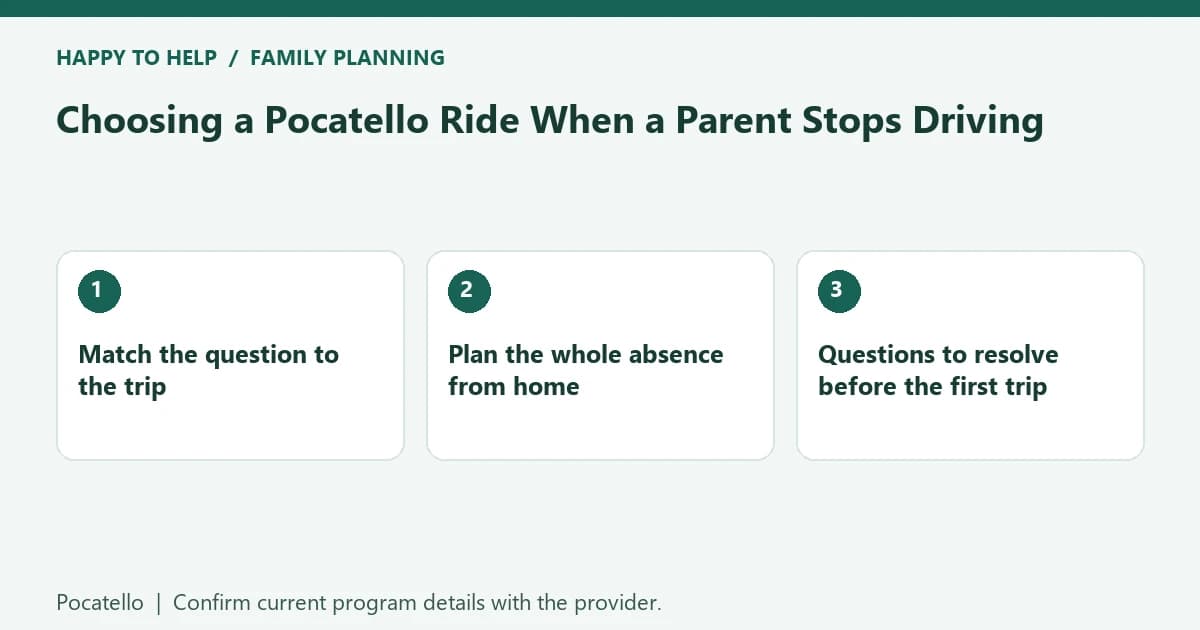
Match the question to the trip
| What the family needs to clarify | Where the conversation starts |
|---|---|
| A disability makes independent fixed-route use difficult | Ask PRT about its Pocatello/Chubbuck ADA paratransit process |
| An older relative needs an ordinary community trip | Ask PRT which senior transportation arrangement fits the address and purpose |
| The proposed journey concerns a Medicaid-covered medical service | Ask the medical-trip coordinator identified by PRT about that particular journey |
This is a way to organize inquiries. It does not determine qualification, authorize payment or confirm a ride.
Describe the difficulty in ordinary terms. For example: “My parent can sit in a vehicle but cannot independently reach the usual bus stop.” Ask the provider what information it needs; do not decide the program solely from your parent's age.
Plan the whole absence from home
Before relying on a booking, write down both addresses, the appointment time, the return arrangement and who will answer calls. Ask about the assistance available at pickup and arrival. A transport arrangement should not be assumed to include dressing, finding paperwork, staying through the appointment or settling someone back at home.
Use a separate line for each commitment:
- Transport provider: the journey it has actually confirmed.
- Family or another agreed helper: preparation, accompaniment or return-home tasks.
- Backup contact: what that person has agreed to do if the plan changes.
If no provider has confirmed a journey, keep the calendar entry marked as an inquiry.
Questions to resolve before the first trip
Ask whether the proposed trip falls within that program's area, how advance arrangements work, and how the return will be handled. Discuss mobility equipment and an accompanying person directly with the provider rather than assuming that one service's rules apply to another.
For non-medical help around the trip, use the Pocatello care page to discuss the exact tasks and proposed visit. A care consultation and a transit inquiry require their own confirmations.