When Caregiving Brings Loss While Your Relative Is Still Living
Reviewed by Tyree Powell, Marketing on .
For families in Washington
For families in Washington, North Central West Virginia & Southwestern Pennsylvania: use the resources and practical steps in this guide to plan wanted nonmedical help. Confirm individual requirements and current availability with the responsible provider.
Changes in memory and family roles can bring sadness for shared experiences or a future that now looks different, even while the relative is living and the relationship continues. Making room for those feelings does not require describing the person as already gone.
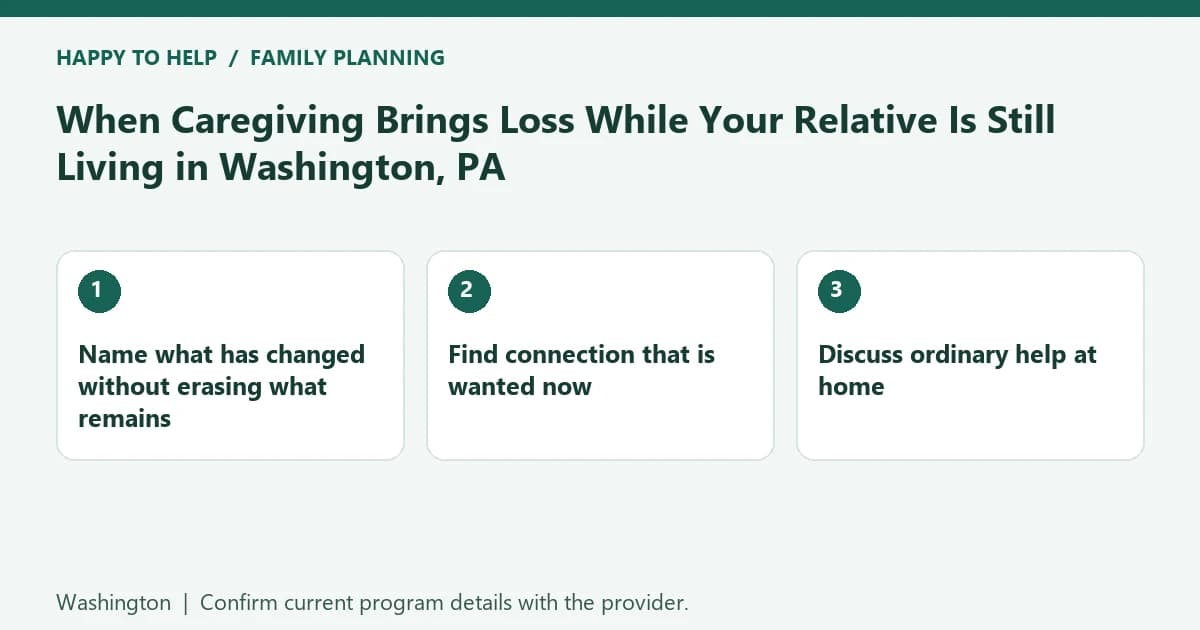
Name what has changed without erasing what remains
You might miss a familiar conversation, shared responsibility or expected retirement plan. Acknowledge that specific loss rather than making the whole person stand for it. Family Caregiver Alliance's ambiguous-loss education discusses this kind of uncertainty; it is educational background, not a diagnosis or a required coping formula.
Sadness and enjoyment can exist together. There is no requirement to reach closure, adopt positive thinking or follow a fixed sequence of grief. The adult is not responsible for relieving the caregiver's feelings.
Find connection that is wanted now
Ask what the person enjoys and how they want to spend time together. A familiar activity can change shape or be declined. Do not make participation in a ritual or family celebration a test of coping.
At the same time, revisit actual family commitments. A changed role may require a new conversation about who can help and what they can sustain. Do not quietly assign every responsibility to the person who feels the most guilt.
If wanted, use SWPA's caregiver-support route to ask about current education or peer support relevant to Washington County. It does not establish a dedicated ambiguous-loss group or a counseling appointment. Seek qualified help for individual concerns while keeping the adult's daily assistance separately confirmed. Support for the caregiver and respect for the living person's choices belong in the same plan.
Discuss ordinary help at home
For separately arranged nonmedical assistance, our Washington care team can discuss the person's requested tasks and timing. Contact the local care team to ask about the actual scope, schedule and available staffing.