Arranging a Designated Medical-Marijuana Caregiver in Washington
Reviewed by Tyree Powell, Marketing on .
For families in Washington
For families in Washington, North Central West Virginia & Southwestern Pennsylvania: use the resources and practical steps in this guide to plan wanted nonmedical help. Confirm individual requirements and current availability with the responsible provider.
For an existing Pennsylvania medical-marijuana patient, an ordinary home aide and a program-designated caregiver are different roles. A willing relative or paid worker should not assume that helping at home authorizes collection through the state program.
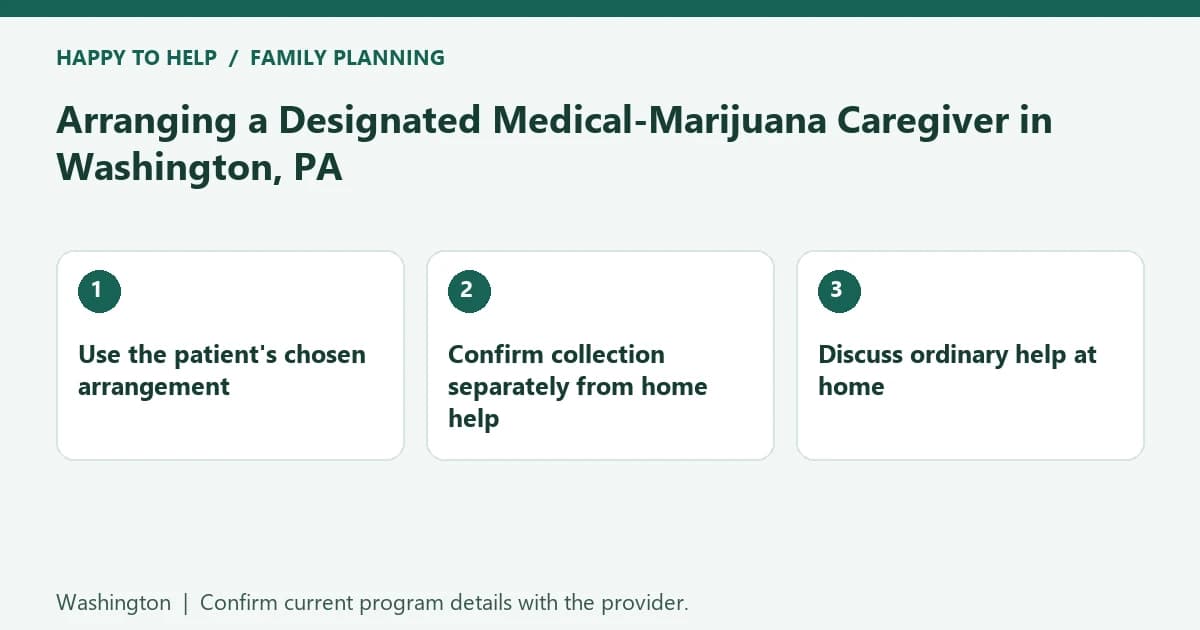
Use the patient's chosen arrangement
With the adult patient's permission, review the Department of Health's patient and caregiver information. Ask the program to explain the current registration, approval, card and patient-linkage requirements for the actual proposed caregiver. A family relationship or clinical proxy should not be treated as an interchangeable substitute for that program role.
The responsible program determines whether requirements are met. This guide does not establish individual eligibility, background-check results, an exception or legal authority. Do not generalize the adult Pennsylvania process to minors, other states or ordinary prescriptions.
Confirm collection separately from home help
Before relying on a person to collect, ask the program to confirm the actual approved caregiver role, current card and linkage to this patient's active certification. A card associated with someone else does not establish this patient-specific arrangement. A submitted application or willing helper is not the same as a valid linked caregiver relationship.
If a paid worker is being considered, the employer must also explain its actual permitted scope and whether it accepts the requested duty. Program status does not automatically change an agency's service agreement.
Keep product, treatment, dosing and other clinical decisions with the responsible practitioner and qualified program professionals. The physician information concerns that distinct clinical role. Separately arrange ordinary daily assistance the patient wants. A completed program designation does not establish that all other care tasks or visits are covered.
Discuss ordinary help at home
For separately arranged nonmedical assistance, our Washington care team can discuss the person's requested tasks and timing. Contact the local care team to ask about the actual scope, schedule and available staffing.