An October 2026 Hospice Addendum: Keep Receipt and Agreement
Reviewed by Tyree Powell, Marketing on .
For families in Waynesburg
For families in Waynesburg, North Central West Virginia & Southwestern Pennsylvania: use the resources and practical steps in this guide to plan wanted nonmedical help. Confirm individual requirements and current availability with the responsible provider.
A hospice addendum can explain items or services the hospice considers unrelated to the terminal illness and related conditions. Receiving that explanation is not the same as agreeing with every entry or making a treatment decision.
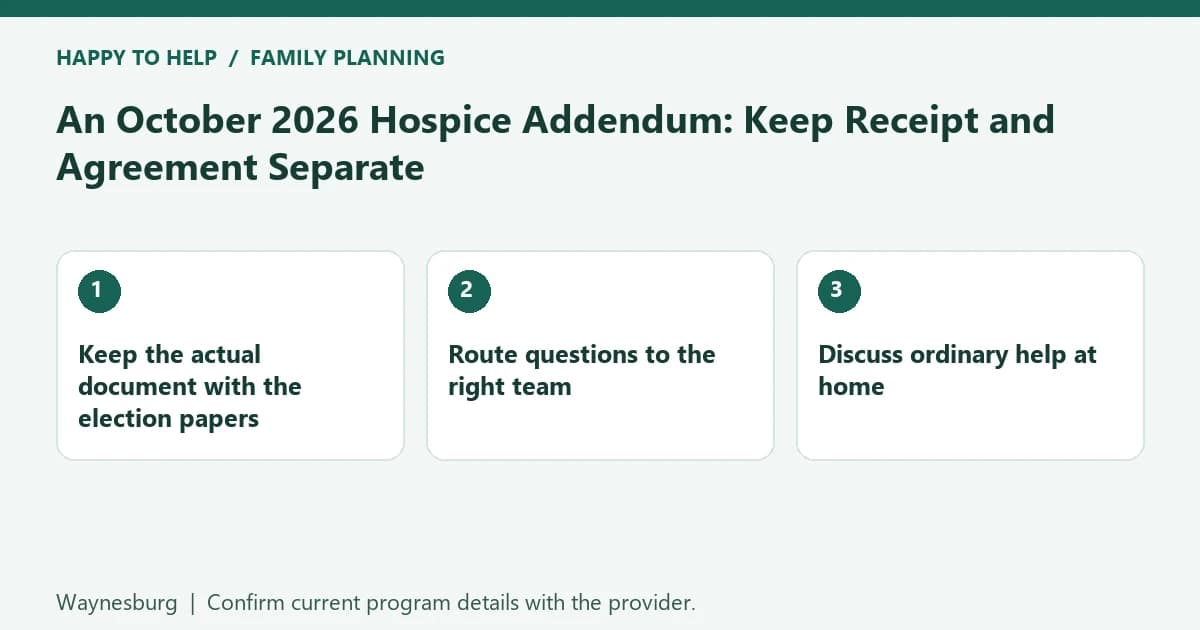
Keep the actual document with the election papers
Ask the hospice to explain the patient's own addendum and any unclear item. CMS's August 2026 model distinguishes hospice elections beginning on or after October 1, 2026; do not treat that new-election requirement as a blanket instruction to recreate every older file. Have the hospice explain the rule that applies to the actual election and any update. The CMS model addendum and election-statement model show the distinction between documents, but a blank national model is not the patient's completed form or proof that a particular agency uses it unchanged.
Keep the actual dated explanation and ask what an acknowledgment means before signing. The patient or properly authorized representative should receive the appropriate guidance; a companion should not sign, backdate or decide coverage on the person's behalf.
Route questions to the right team
Ask the hospice why an item appears and which responsible professional can explain its relationship to the care plan. With permission, share the document with other treating providers who need it. Do not stop a medicine or service because a nonmedical helper interpreted an entry.
For disagreement with the hospice's unrelated-item determinations, the model identifies Immediate Advocacy through the BFCC-QIO. Ask the actual hospice or Medicare route about the appropriate contact; this is distinct from a home-health termination notice review and does not promise coverage. For help understanding an explanation, ask the responsible team to clarify the actual document. CMS announcements provide current national context, not an individual claim determination or legal remedy.
Separately confirm ordinary home assistance. A document received, a clinical question answered and a caregiver scheduled are different milestones. The family's useful role is keeping the actual explanation accessible and ensuring unresolved questions reach the responsible people.
Discuss ordinary help at home
For separately arranged nonmedical assistance, our Waynesburg care team can discuss the person's requested tasks and timing. Contact the local care team to ask about the actual scope, schedule and available staffing.