Which Aging Office Should Pocatello Families Call Now
Reviewed by Tyree Powell, Marketing on .
For families in Pocatello
For families in Pocatello, East Idaho: use the resources and practical steps in this guide to plan wanted nonmedical help. Confirm individual requirements and current availability with the responsible provider.
When two websites identify different aging-resource contacts, use the state's current county directory to choose the first inquiry. Record which organization confirms responsibility for your address instead of trying several unrelated applications at once.
The Idaho Commission on Aging's current directory lists Bannock County under AAA East and provides EICAP contact details. Some older regional references remain online, including a historical link on Pocatello Regional Transit's website. An old regional label is a reason to check the current directory, not evidence that public help has disappeared.
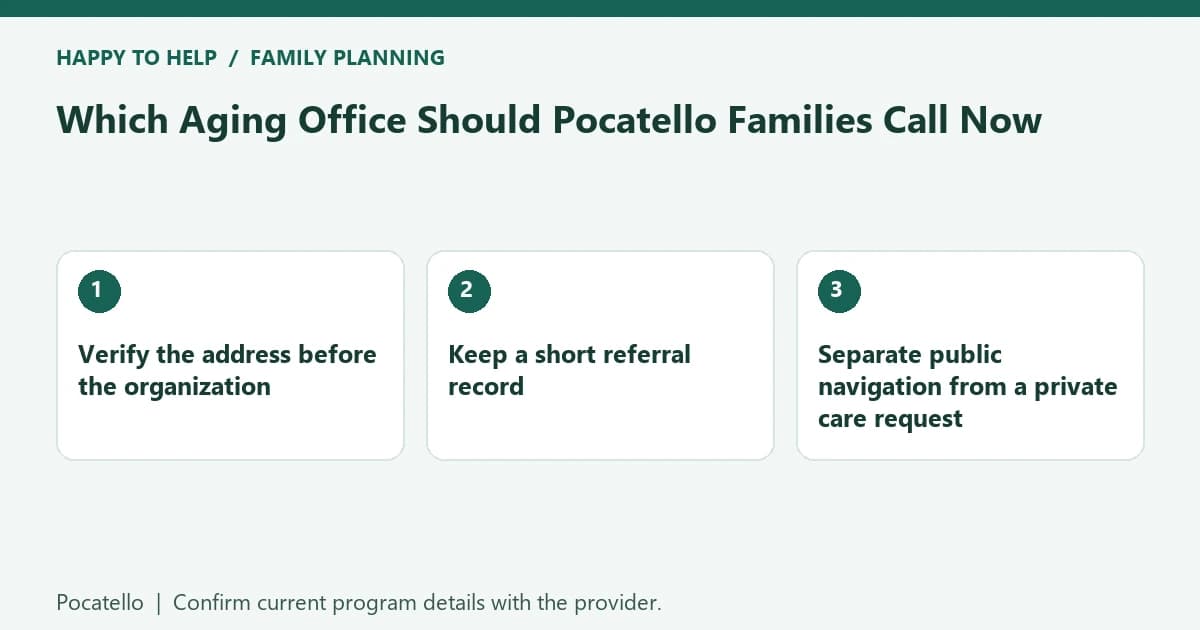
Verify the address before the organization
Prepare the city and county where support is needed. If an adult child is calling from elsewhere, use the parent's care location rather than the caller's home address.
A useful opening is: “We need information about daily-life support for a household in Pocatello, Bannock County. Does your office handle the first inquiry for this address?” This lets staff correct the route before private care details are shared.
EICAP directs senior-program inquiries to its information-and-assistance staff at 208-542-8179. Ask which staff member or service should receive the next question and whether another organization handles the particular need.
Keep a short referral record
Write down:
- The current page used and the date checked.
- The organization that confirmed the geographic route.
- The service requested, such as caregiver support or a meal-program inquiry.
- The next action, its owner and any requested follow-up.
- Whether anything has been approved or scheduled.
Keep “gave us information,” “requested an assessment” and “confirmed a visit” as separate statements. A helpful telephone conversation does not establish funding, eligibility or a caregiver's arrival.
Separate public navigation from a private care request
The public-resource inquiry may help the family understand options. It does not replace a provider discussion about a specific schedule, task list or written estimate.
If support at home is needed while the family explores resources, bring the same concise task list to the Pocatello care team. Ask the team to confirm which tasks and times it can cover. Avoid building the household schedule around either public or private support until the relevant provider confirms its part.