Calling Direction Home Akron Canton: A Family Preparation Guide
Prepared with AI assistance for Happy to Help Caregiving. A separate AI review checked this practical guide against the linked sources on 2026-11-15. This is not a clinical or professional benefits review.
Sources checked during AI review
- www.dhad.org (checked 2026-11-15)
- www.dhad.org (checked 2026-11-15)
- happytohelpcaregiving.com (checked 2026-11-15)
- happytohelpcaregiving.com (checked 2026-11-15)
Previous publication attribution: Tyree Powell, Marketing. Review recorded for Tyree Powell, Marketing on 2026-10-19. That attribution does not approve this AI-assisted revision.
For families in Akron
For families in Akron, Northeast Ohio: use the resources and practical steps in this guide to plan wanted nonmedical help. Confirm individual requirements and current availability with the responsible provider.
For an Akron household exploring long-term support, begin with the aging agency serving Summit County. A broad “Northeast Ohio” label does not identify the correct public-resource route.
Direction Home Akron Canton identifies Summit County within its service region. Its Aging and Disability Resource Center describes telephone needs conversations, information and referrals, and in-person assessments when feasible. The ADRC contact is 877-770-5558.
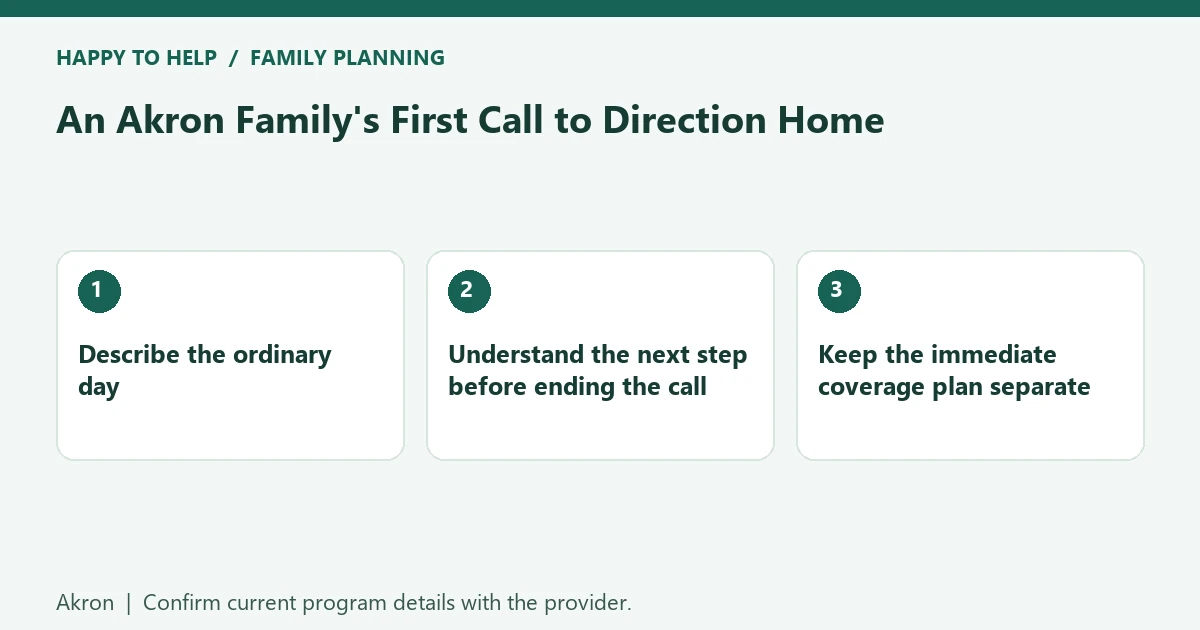
Describe the ordinary day
Before calling, prepare a short account of the person's routine:
- Which tasks the person wants to do independently.
- Where help is needed and how often.
- What family, friends or existing providers already cover.
- Which gaps are causing the immediate difficulty.
Concrete examples are more useful than a request for “everything.” A person may need help getting ready in the morning, obtaining food or spending time safely at home while a relative is away. Let the agency explain what information it needs to explore the appropriate options.
If the person wants a family member involved, ask how the agency handles that involvement and information sharing. Do not assume a relative automatically has authority to complete every step.
Understand the next step before ending the call
Direction Home describes assessment and screening as ways to identify needs and program options. Ask whether the next action is a referral, a further assessment, an application or contact with another provider.
Record the organization responsible for that next action and how to follow up. A useful note distinguishes an inquiry from an assessment and an assessment from a confirmed service.
Leave benefit eligibility, application decisions and payment questions with the responsible program. A general resource conversation does not establish that a home-care visit, meal delivery or other assistance has been approved or scheduled.
Copy a short call-outcome note
Before ending the conversation, read back what you understand the next step to be. Use this note to distinguish information you received from an action that has actually been arranged.
| What to record | The answer from this conversation |
|---|---|
| Date and the organization or team reached | |
| What happened today: information, referral, assessment discussion or another step | |
| Who is responsible for the next action | |
| Information the organization asked you to provide through its process | |
| How and when to ask about progress, as discussed on the call | |
| Any service or appointment actually confirmed, and what remains open |
Here is a fictional example: the caller receives information about a local resource and is told to contact it. The note says resource information received; next contact still to make. It should not say that a visit or program place has been arranged.
If another relative will make the next call, agree on the handoff and share only the information they need and are permitted to receive. A name written in the note does not establish that the person has accepted the task or has authority to act for someone else.
Use the agency's own instructions for documents, applications and further assessment. The note helps you remember the conversation; it does not decide program eligibility or complete those steps.
Keep the immediate coverage plan separate
While exploring resources, identify what will happen today and during the coming week. Note the tasks family can cover and the visits or services that remain unconfirmed.
For a separate conversation about nonmedical caregiving, our Akron care page connects families with our Northeast Ohio team. Use the regional contact page with the care address, daily tasks and preferred visits. Confirm staffing and written arrangements independently from Direction Home's assessment or program process.